





Celebration of Hungarian Science 2025
At our institute, the celebration of Hungarian science is primarily manifested in the fact that on one day in November each year, we welcome enthusiastic and curious students from five secondary schools, whom we receive not only with a lovingly and carefully prepared program, but also with a lavishly laid table. And as the reports show, quite a few of them consider the latter worthy of special thanks.
When an event has a history stretching back decades, it can easily become dull. In addition to the changes required everywhere by the events of recent years, our student audience, which usually indicates whether it is satisfied or would like to see changes, helps to ensure that not only the titles and speakers of the lectures change, but the event itself. We said goodbye to teachers we had known since the beginning of this series and welcomed new ones for various reasons, and we even invited a new school. This year, we also changed the program because we took on board some of the suggestions we received after last year's event.
That is why this year there was one more presentation, five in total, but instead of 30 minutes, they were 20 minutes long, and after the introduction and two presentations, there was a 10-minute break, which was indeed ten minutes long because everyone kept to the time. Our speakers were also very careful not to exceed the allotted 20 minutes and always kept in mind how much detail was necessary and sufficient for understanding their topic and message.
But praise is also due to our students, who, in groups of ten, took turns so quietly and orderly during the afternoon program's lab visits that it did not disturb the presentation being held in the lecture hall on the other side of the same corridor!
We waited a little excitedly for the evaluation of this year's event.
Mr. Péter Nagy always carefully edits the opinions of the students of Fazekas High School, so even those who were not there can get a picture of the entire event.
"From Dániel Kuti's lecture, we learned how much the microbiome can provide a basis for new treatments and research opportunities, as well as how unexplored this field still is.
In Judit Veres' presentation, it was particularly interesting to learn that we actually have little understanding of why and how our emotions arise, and to what extent an accident can completely change our personality.
The topic of Borbála Kertész's presentation was completely new to us. It was good that, in addition to the biological applications and results of two-photon microscopy, we also learned about the physical background and operating principle of the technology in detail. It was also interesting that there was a lot of talk about practical applications, which helped us to better understand its significance.
After a short break, Erik Hrabovszky's presentation on intersexuality was particularly exciting, as this is a topic that is rarely discussed, especially in such detail. Unfortunately, I found the second part of the presentation a little difficult to follow.
The last lecture was given by Zsófia Maglóczky, and the topic was extremely interesting. It was particularly exciting to learn about the extent to which different animals show signs of intelligence and in what forms of behavior. The philosophical nature of the whole topic also added to the interest of the lecture.
Of the five afternoon laboratories, the VR (virtual reality) mouse lab stood out for me. It was very kind of the presenter (Manó Aliczky) to put the mouse in the device for us to show us exactly how the measurement is done.
The observations of the high school students from Baár-Madas High School, who arrived with their teacher Dávid Vetlényi, drew attention to values that we want to preserve in the future:
"In addition to the lectures, we particularly liked the fact that during the lab visit we got an insight into the work going on at KOKI, gaining valuable experience that may even help us in our career choices."
"I really liked that during the lab visit, they not only explained the theory, but also demonstrated the operating principle, and we had the opportunity to try things out for ourselves."
"It was good to see that the lecturers and researchers we met in the laboratories love what they do and were able to share that with us."
Dr. Anna Solt, a teacher, arrived with students from Városmajori High School. The students' comments showed that they noticed and appreciated kindness, and that what makes research work attractive to them is that the people they met love what they do.
"It was particularly exciting to see the different tools, laboratories, and the variety of neuroscience research, but what came across most was the kindness and dedication of the researchers and lecturers. I think that for those preparing for a similar career, it is best to see that they too can be similarly happy and enthusiastic."
"I really liked the whole program. The lectures were interesting, and I think the lecturers did a great job of conveying their knowledge to us high school students. I especially liked that I got to see several types of microscopes (such as electron microscopes and fluorescence microscopes) during the lab visits. Both the lab workers and the lecturers were very friendly, and it was great that we could ask them all our questions on the topics, which they always tried their best to answer. For me, programs like this always give me an extra boost to learn, because I can see that if we are persistent enough, we too will be able to do research on similar topics."
"The lectures were very enjoyable and of a high standard."
Thank you!
Teacher Tünde Szalayné Tóth did not accompany her students this year as she has retired. The students of the Lovassy László Gymnasium in Veszprém were accompanied by their young teacher, Eszter Fleischer-Dósa. Our visitors recalled particularly interesting details with palpable enthusiasm:
"The program opened with a presentation on the importance of research (László Acsády). This was followed by several researchers briefly presenting their current projects. We heard about the development of new diagnostic procedures, the genetic coding of emotions, and the importance of the microbiome. We learned that the institute is home to several research groups conducting research in various fields, such as molecular biology, cell biology, neurobiology, and biotechnology.
During the lab visits, we were able to see several rooms and the research groups' modern instruments, such as fluorescence and electron microscopes. The researchers emphasized that their work processes are conducted in accordance with strict ethical standards.
I learned a lot of new and interesting information at KOKI, and my favorite lectures were those on emotions and intelligence. I was impressed by the speakers' in-depth knowledge. During the afternoon sessions, we gained insight into the research, the operation of different types of microscopes, and the process of animal experiments. Thank you for the opportunity and the warm welcome!"
"When we entered the building of the Institute of Experimental Medicine, we were immediately greeted by a large table full of all kinds of delicacies (including gluten-free options), so we were impressed even before we had heard any of the lectures. During the day, we learned a lot of interesting information about animal intelligence, emotions, the microbiome, and two-photon microscopy. In addition, we were given a glimpse into the operation of the institute's microscopes and the process of research with mice. I am very happy that we were able to participate in this program, and I am sure that it has inspired many of us to continue our studies."
"The event was excellently organized, and the organizers paid special attention to ensuring that the programs started on time. We listened to extremely exciting lectures on the brain and nervous system from renowned and well-known speakers. It was a great experience and an honor to listen to these experts, and we also had the opportunity to ask questions. Afterwards, we were able to gain insight into ongoing research during laboratory visits. It was insightful and inspiring to listen to the experts working there talk about their work and demonstrate the tools they use or the experimental animals they work with. Overall, it was a very good experience and we were very happy to be invited."
"I was most impressed by the advanced technology, and I really liked the exercises demonstrating the microscopes. I hope that I will have the opportunity to study them more seriously during my university studies.
"It was a great opportunity to expand our knowledge of the brain. There were many exciting programs and lectures. For me, the most interesting were the practical lectures."
This was the first time we invited students from the Veres Péter High School in Békásmegyer, who arrived under the guidance of teacher Andrea Boncz. Along with their short reports, the students also sent a photo taken in the institute's lobby, which captured a group of students looking a little serious, a little smiling, confident, and satisfied.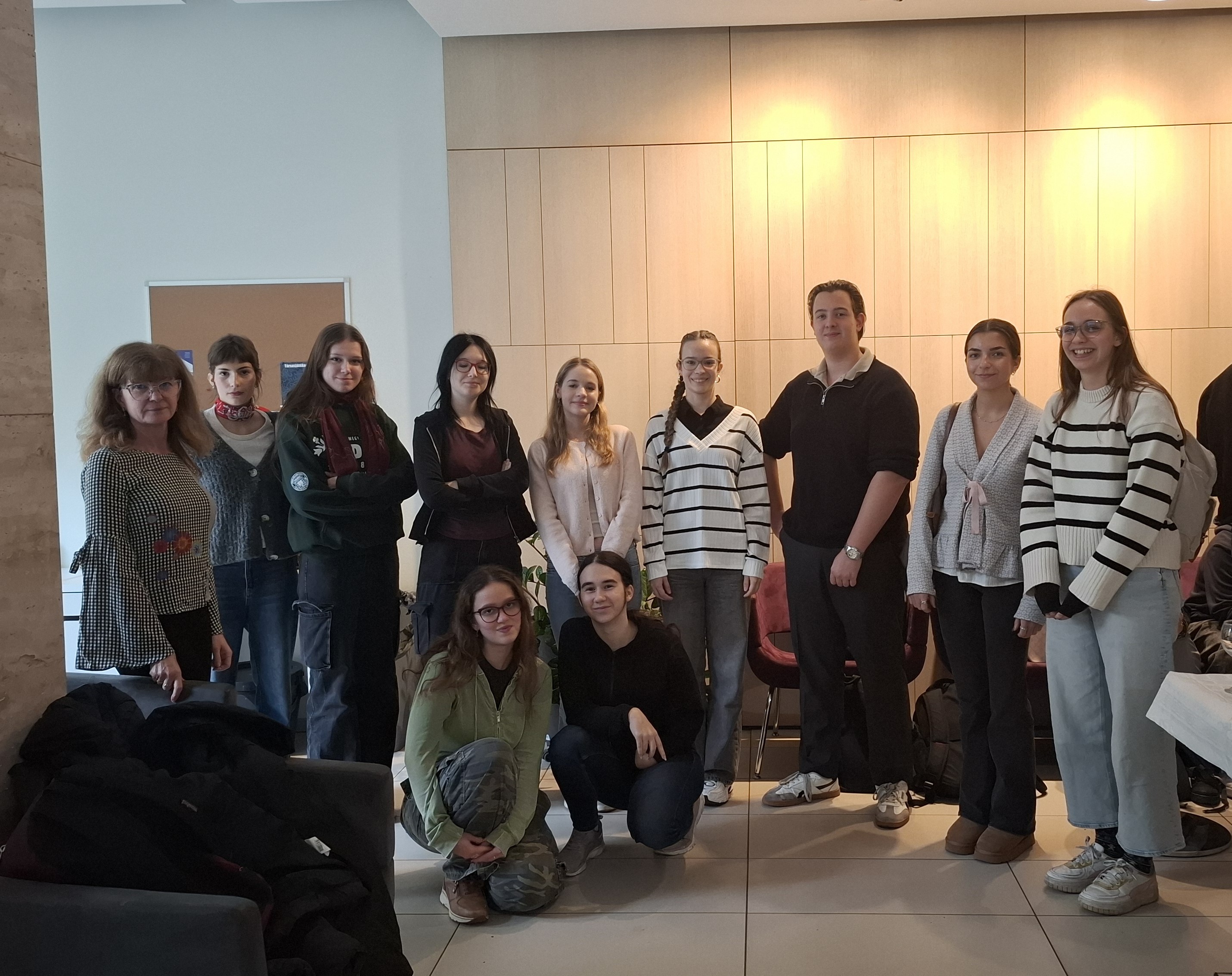
"The lectures were very interesting, we learned many new and surprising things, and we had several 'aha' moments when the information we had learned so far connected and made sense."
The reception was also outstanding: the sandwiches were delicious and the hot coffee was pleasant. We also enjoyed the lab visits; it was a great experience to use the electron microscope, the treadmill simulation used for mouse research, and the other programs. Getting to the labs was a bit of an adventure, but everything was perfect. Thank you very much!"