





How the Brain Links Fear to Negative Memories
When we recall an unpleasant memory, we do not simply replay it as detached observers watching a scene from a film: we often re-experience the emotion, including the fear, associated with the original event. Researchers at the HUN-REN Institute of Experimental Medicine are helping to explain how the brain links the retrieval of a memory to the accompanying feeling of fear. Their findings shed light on how persistent activity in this system may contribute to anxiety, post-traumatic stress disorder and depression.
Boldizsár Balog and colleagues, led by Gábor Nyiri, identified a neural pathway in the mouse brain that links forebrain regions involved in memory retrieval with deeper brain centres that regulate emotional states.
Memory-related information from the hippocampus and amygdala reaches a specific group of cells in the medial prefrontal cortex, which is itself part of the classical cortical memory system. The researchers found that these cells directly connect to neurons in the median raphe region of the brainstem and, among other targets, influence the lateral habenula, a brain region with an important role in regulating negative emotional and motivational states including depression.
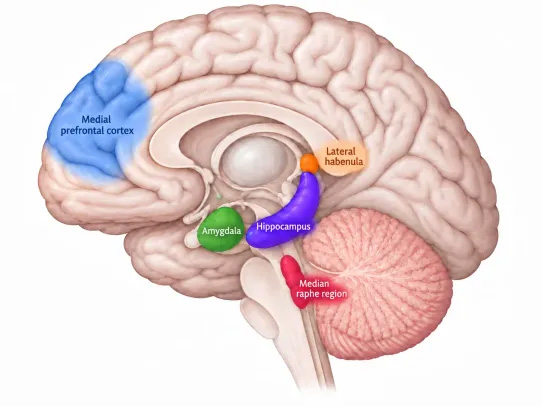
Inhibiting the pathway reduced the fear response
The findings suggest that this pathway does not store the memory itself. Instead, it plays a key role in reinstating the negative emotional state associated with the memory when that memory is retrieved. When the researchers conditioned the animals to associate a particular environment with fear and then selectively inhibited key cells in the pathway during subsequent memory retrieval, the animals showed fewer signs of fear. The gradual extinction of the fear response was also accelerated.
Chronic stress also altered the activity of this system
This may be important because the pathological retrieval of negative and traumatic memories can play a role in conditions including anxiety, post-traumatic stress disorder and depression. In the researchers’ experiments, prolonged stress caused the same brainstem neurons to remain hyperactive even several days later. Sustained inhibition of these cells in stressed animals reduced depression-like behaviour, specifically it restored normal reward-seeking behaviour. Accordingly, ketamine treatment – which is also used therapeutically in certain cases of depression – reduced the stress-induced hyperactivity of these neurons.
A potential new target for research into stress and mood disorders
Another important finding was that neurons characteristic of this cell type were also identified in the brains of non-human primates (monkeys). This is significant because it suggests that some elements of the system identified in mice may also be present in more evolutionarily distant mammalian groups. The researchers also identified specific ion channel and neurotransmitter receptor genes that may offer potential targets for future therapies.
The research team’s findings may provide a cellular-level explanation of how the brain links a retrieved memory with its associated negative emotional state. They also bring us closer to understanding how persistent or excessive activity in this system may contribute to the pathological retrieval of negative memories, and how this neural pathway could potentially become a future therapeutic target for stress-related and mood disorders.
The work was published in the Nature Communications.
The original article is available on the HUN-REN webpage