





Our winners of the HUN-REN Innovate 2026 competition: Csaba Fekete and Szilamér Ferenczi
This new call for proposals is not about basic research. KOKI does not typically participate in calls like this. The winning teams were expected to demonstrate the technological maturity of their developments, as well as the project’s feasibility in addition to its anticipated social and economic benefits—and yet, two applicants from KOKI were among the 14 winners. Hats off to them!
Applications for the HUN-REN Innovate 2026 Call for Proposals were submitted in the fields of healthcare, biotechnology, agriculture, industrial digitization, and physical sciences; “the funded projects will focus on technological validation between 2026 and 2028.”
For more information about the award ceremony, visit the hunrentech.hu. Among our winners, Csaba Fekete and Richárd Sinkó share with us how and why they were able to win.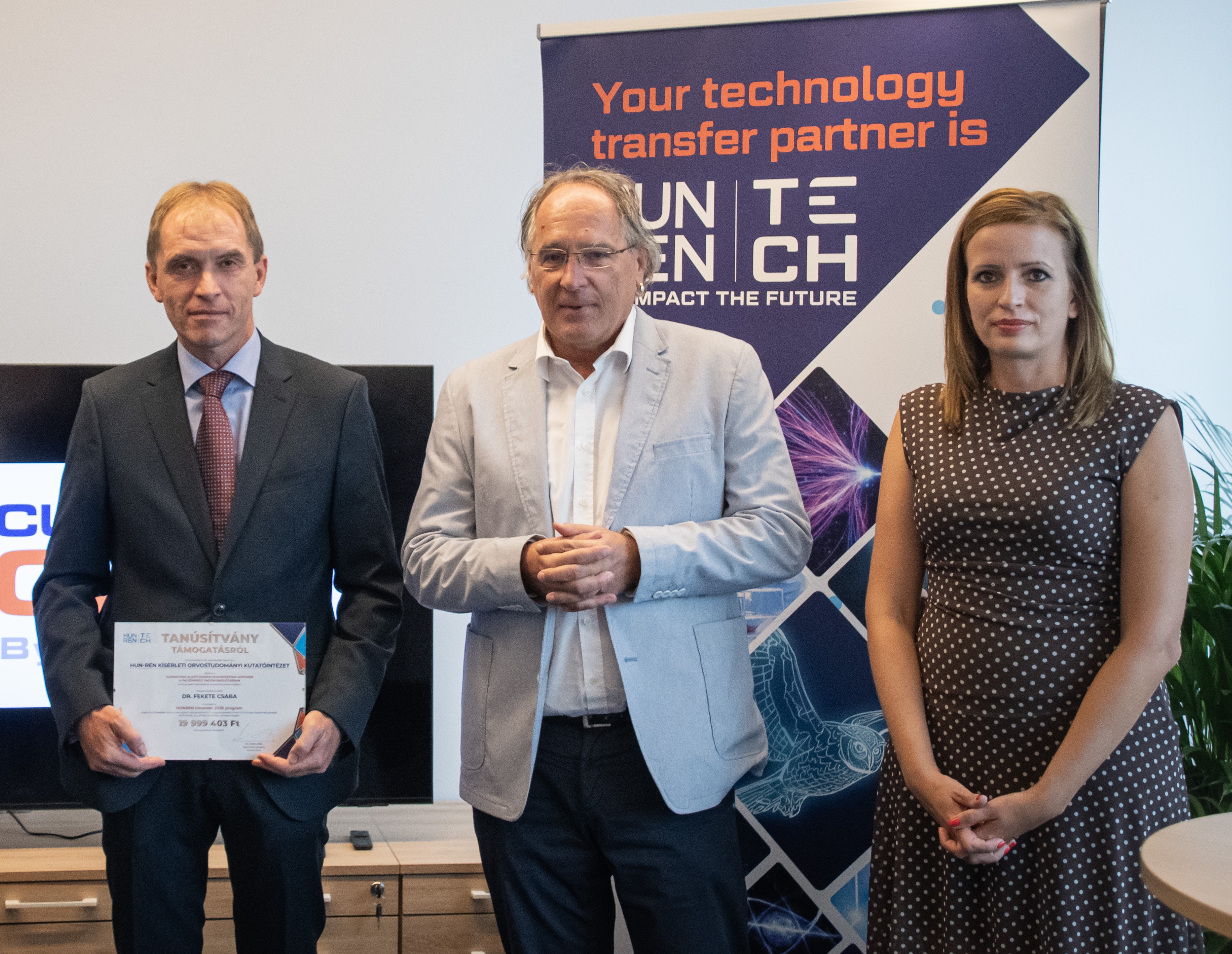
-The call for proposals was issued by HunrenTech Kft., a technology transfer company, to support innovative basic research topics, and we were awarded a grant of 20 million forints for one year to further develop our diagnostic method for investigating the effects of human thyroid hormone derived from hair bulbs.
This project has been based on close collaboration from the very beginning; therefore, all inventors named in the patent application that forms the basis of the procedure—namely, Balázs Gereben, Richárd Sinkó, and Csaba Fekete—are participating in the implementation of the grant. From the very beginning, we have been working as external partners with endocrinologist Prof. Endre V. Nagy and his research group at the University of Debrecen; our collaborating partner is István Miklós from the HUN-REN Alfréd Rényi Institute of Mathematics; and Balázs Göcz from the Reproductive Neurobiology Research Group has also joined us to assist with our work.
- Could you say a few words about the invention itself?
- As previously reported on the KOKI website, we are working on a hair follicle-based diagnostic method that makes it possible to measure the tissue effects of thyroid hormones in humans. Currently, one of the most important tools for diagnosing thyroid hormone status is the measurement of circulating hormone levels, which do not always correlate with the patient’s clinical condition, posing a serious dilemma for the treating physician: should they trust the lab results or the patient’s condition? Our goal is to provide clinicians with a supplementary diagnostic tool that, in contradictory cases, can aid in medical decision-making by complementing existing methods.
One such contradictory clinical condition is amiodarone-induced hyperthyroidism, where we have previously successfully applied the “alpha version” of our diagnostic method—which was specifically intended for research purposes.
- So you needed this grant to further develop your method!
-Yes, with the support of the HUNREN Innovate 2026 Program, we would like to further improve the performance of this diagnostic method. More specifically, we want to focus on the diagnosis of mild cases of hypothyroidism and hyperthyroidism, where hormone levels deviate only slightly from normal. The occurrence of this condition during hormone therapy in patients with hypothyroidism can also lead to the persistence of certain symptoms and pose diagnostic challenges. It has long been a matter of debate when and how these conditions should be treated. We are convinced that our diagnostic method can be applied in such cases as well, and that with its help, the treating physician can make personalized decisions for individual patients. To this end, we are searching for and validating new marker genes, as well as developing new machine learning models, in order to advance from the initial prototype stage of the method to a more advanced version.
- How did the application process work?
- Applications were evaluated through a multi-stage process, and the rounds were structured somewhat differently from what we are used to in the funding programs we typically apply for. In the first round, they asked for a brief work plan that focused primarily on the triad of problem, idea, and expected impact: why the topic is novel, what problem it aims to solve, and what its long-term goal might be. Applicants who advanced from the first round were expected to submit a brief presentation with a similarly innovative approach. To do this, we had to look at our own work from a new perspective.
- That couldn’t have been easy!
- HunrenTech was a big help. They organized training sessions and auditions where we received practical advice on how to effectively present a research project from an innovation perspective, and we also gained a better understanding of what potential investors will expect from such a presentation later on.
Overall, the application process clearly illustrated the mindset and expectations of the players in the innovation ecosystem. We found this very useful because, although this is a basic research grant, the program also greatly helps researchers prepare for later stages of development.
- Why are you targeting this particular grant?
- Our diagnostic method for assessing the effects of human tissue thyroid hormone derived from hair follicles, is not yet at the stage where we can move toward commercialization by attracting private capital; however, it is already sufficiently advanced that it is not an ideal fit for traditional basic research grants. It was particularly difficult to find adequate funding at this stage of development, so we were truly delighted by this opportunity.
- It was a good idea, since you both learned a lot and won the grant. What did you take away most from the training sessions that you found important?
- We believe it will become increasingly important for us, as researchers, to learn how to take a scientific finding further after the research is complete. In our research, we primarily ask new questions about how to conduct experiments to answer a scientific problem and how to generate new knowledge. However, the practical application of a promising finding requires an entirely different way of thinking and a different set of skills. This aspect of innovation is still new territory for us, so we need all the professional help, advice, and support we can get.
- For most researchers today, this isn’t yet an obvious priority; many may not even be particularly interested in it.
- That may be true, but it’s becoming increasingly clear that a scientific result alone is not enough for successful commercialization. Protecting intellectual property, obtaining licenses, developing a business model, and finding the right clinical and, later on, even market partners are all areas that require specialized knowledge and experience. We don’t think that, as researchers, we need to understand all of this ourselves, but we do need to learn when and what kind of expertise we need, and how we can bring in the right partners.
- That sounds much more reassuring and is certainly acceptable. But finding the right expert can’t be that easy either . . .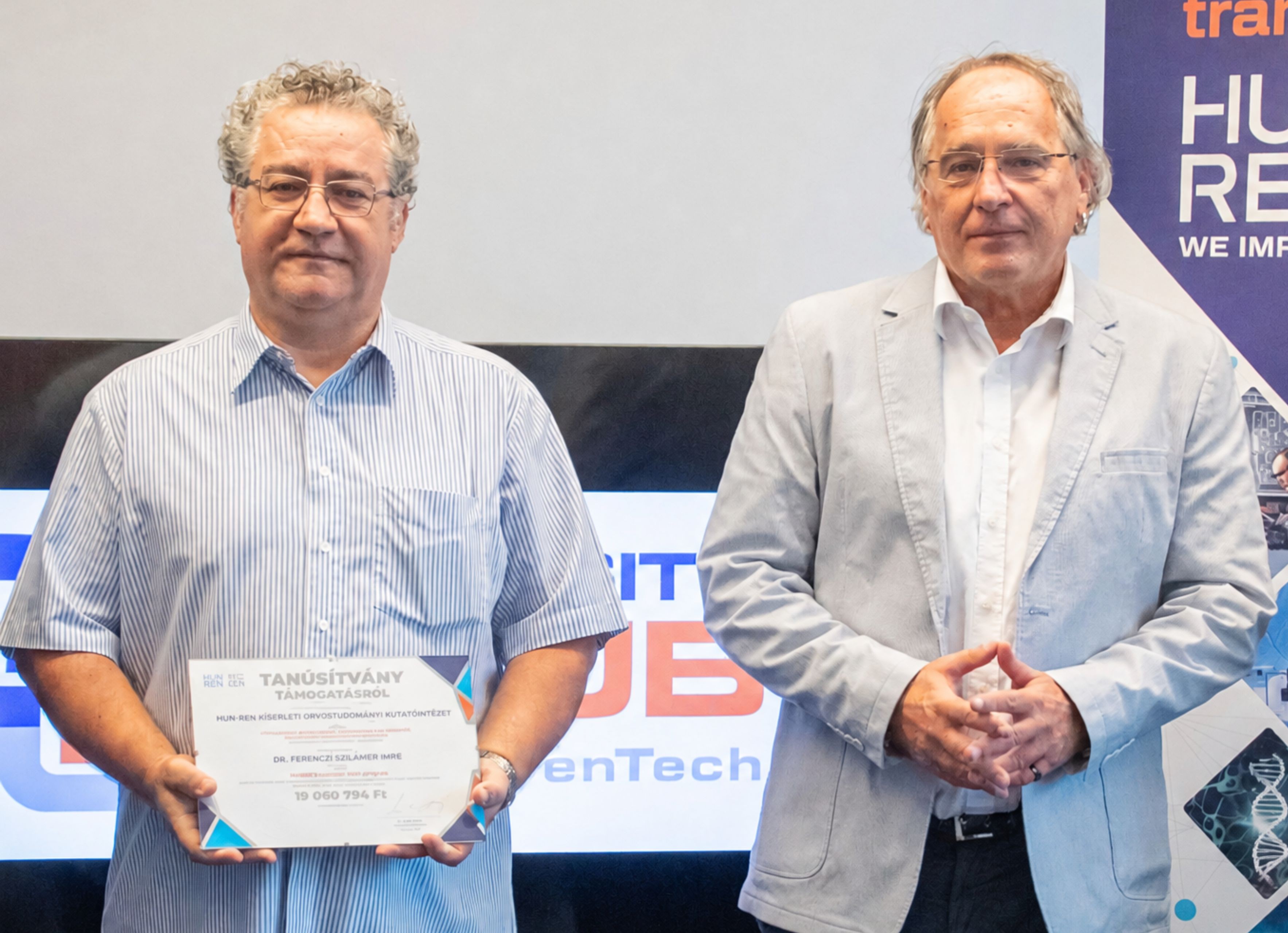
- That is why a well-functioning innovation environment would play such an important role! Not only do most researchers lack a clear understanding of what expertise is currently needed, but we also generally lack the necessary social capital. We, too, actively sought out clinical partners, collaborators, and experts in patents, personal data protection (GDPR requirements), and regulatory approvals. Fortunately, HunrenTech assisted us with advice and connections. However, researchers’ initiative remains critical. Ideally, as researchers, we would be able to focus on coming up with new, innovative ideas, which the technology transfer community would then take over from us.
- What do you think is the reason for your success so far and the key to a successful future?
- From the very beginning, the development of a diagnostic method based on human hair follicles—designed to assess the effects of thyroid hormones on tissue—has attracted considerable interest from clinical partners, who have supported the project with their expertise and active participation. To ensure the success of this innovation, close collaboration between the scientific and clinical sides will remain essential in the future. We are grateful to continue to have the trust and dedication of our partners by our side.
Funded projects:
Title of Szilamér Ferenczi’s project: INNOVATE 28 — Production of recombinant bacteria for the treatment of inflammatory bowel diseases. Grant amount: 19,060,794 forints
Title of Csaba Fekete’s project: INNOVATE 21 – A hair bulb-based human diagnostic method in thyroid endocrinology. Grant amount: 19,999,403 forints
Funding for the Hunren Innovate 2026 Program is provided by the NKFI Fund’s Proof of Concept program, identification number 2024-2.1.3-POC-2025-00002. The program’s beneficiary is HunrenTech Kft., which, as a HUN-REN quality pre-screening technology transfer company, distributes the funding to research institutions. From the 350 million forint funding pool, 14 successful research projects are expected to advance to the technology validation phase between 2026 and 2028, where, in addition to scientific results, the potential for commercialization will also play a decisive role. The program is administered by HunrenTech Kft., the technology transfer company of HUN-REN.
The photos in this article were taken by HunrenTech